
Follow the Work: A Practical Review of Forced-Labour Risks
Start with the work being done
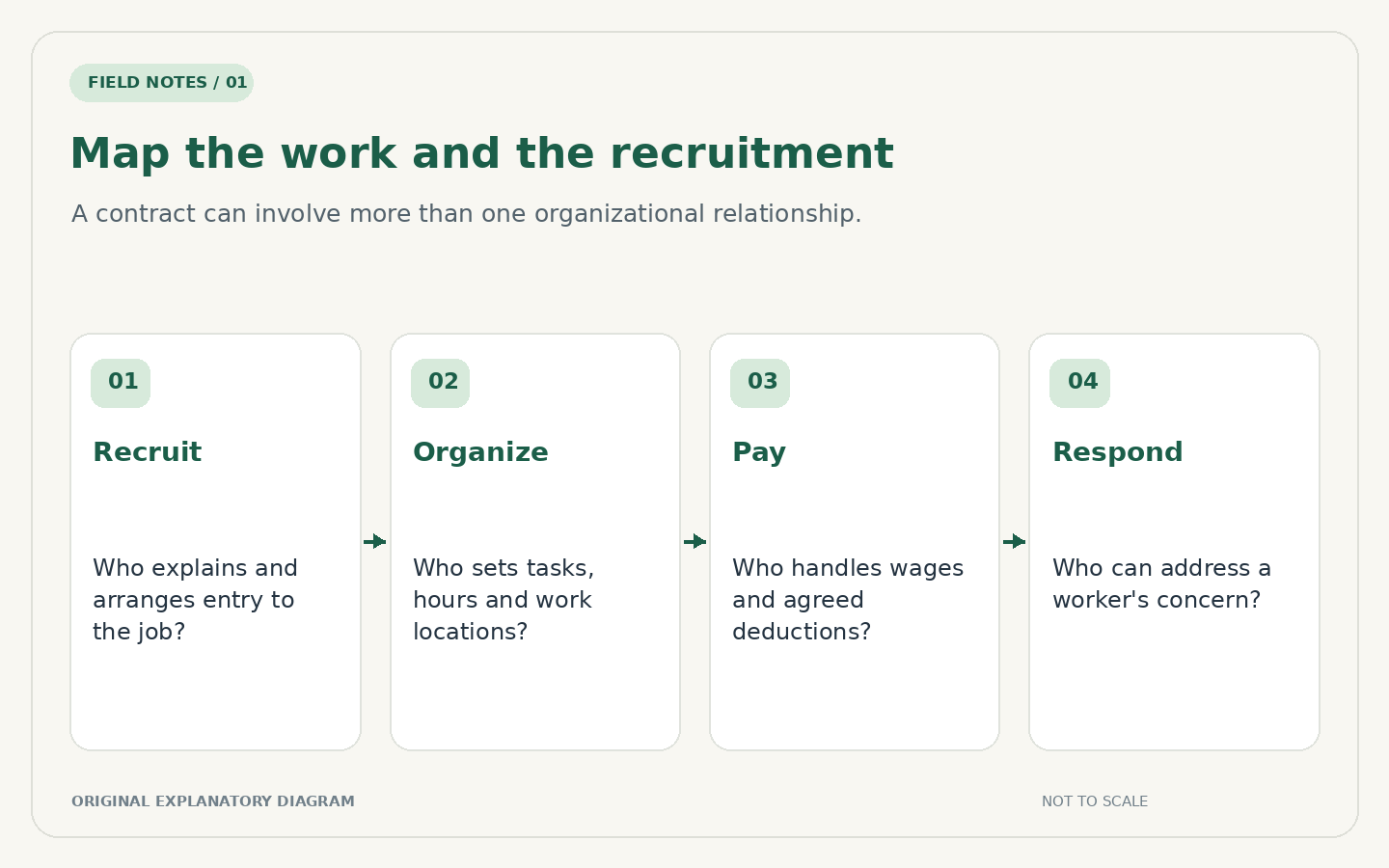
A supplier statement can describe a commitment while leaving the actual work arrangement difficult to understand. Who recruits the workers? Who sets the hours? Which organization pays them? Who handles a complaint? These questions turn an abstract promise into a practical map. They are useful for a purchasing team, a community organization reviewing its contracts, or a reader trying to understand a public supply-chain statement.
Begin with one service or product and describe the work involved in ordinary language. Include temporary work, subcontracting, and recruitment arrangements when they are known. Leave gaps visible rather than drawing a neat chain that assumes every relationship is understood. The aim is to identify where further responsible inquiry belongs, without making unsupported allegations about a business or the people who work there.
Understand what an indicator contributes
The International Labour Organization's revised 2025 indicators guide describes signs of coercion and lack of consent that can support detection and further investigation of forced labour. It presents indicators as practical tools, rather than an exhaustive substitute for assessment. An observation can therefore raise a serious question without settling every factual or legal issue surrounding it. [1]
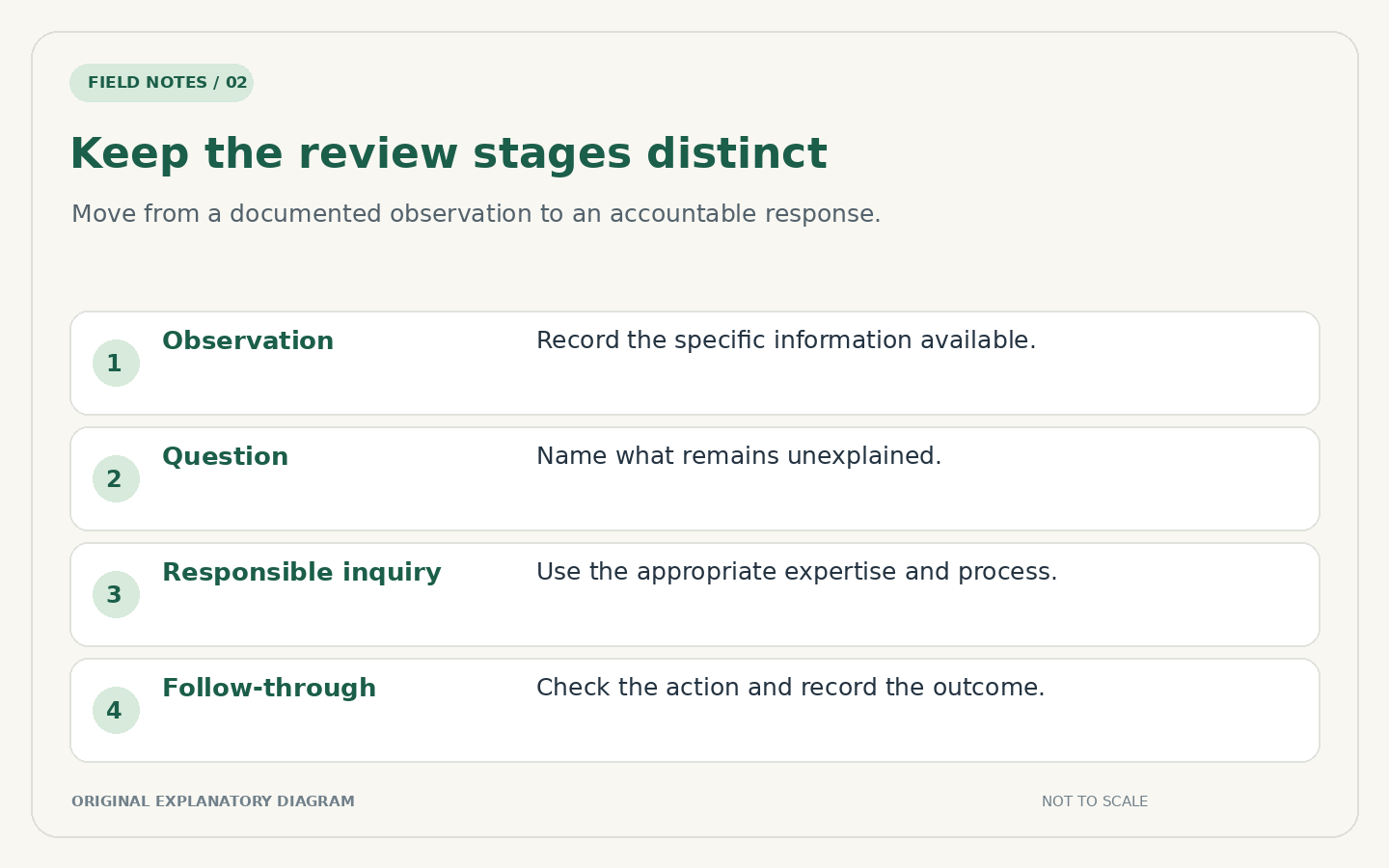
Keep three things separate in a review note: what was observed, the concern it raises, and the inquiry needed to clarify it. For example, a contract describes one recruitment process, while another document refers to an additional intermediary. The immediate finding is an unexplained relationship. Recording that accurately creates a clearer next step than either dismissing the discrepancy or announcing a conclusion that the available material cannot establish.
Trace recruitment as carefully as production
A diagram of factories or service locations may omit the route through which people enter the work. Add a recruitment layer to the map. Ask which parties advertise the role, explain its terms, arrange travel where relevant, and communicate any costs or deductions. Identify the records that would clarify those arrangements and who is responsible for providing reliable answers.
Use consistent questions across comparable contracts. Otherwise, a polished presentation may receive less scrutiny than an unfamiliar company with a modest website. Where workers' experiences are needed, obtain appropriate specialist advice about a safe process. Publicly requesting sensitive accounts or approaching workers through the person who controls their employment can create problems that a desktop review is poorly equipped to manage.
Make worker participation a real design question
OECD's due-diligence guidance treats responsible business conduct as an ongoing process for identifying and addressing adverse impacts, with stakeholder engagement and appropriate remediation among its practical concerns. This directs attention beyond the existence of a written policy toward how concerns are heard, examined, and acted upon. The guidance is a framework; applicable legal duties still depend on the relevant jurisdiction. [2]
Ask how a worker could raise a concern without needing to interpret a complicated corporate chart. The answer should identify an understandable route and the people responsible for it. Then ask whether the process has been assessed from workers' perspectives. A contact address printed on a poster tells you that an address exists. It leaves open whether the route is accessible, trusted, responsive, and appropriate for the concern.
Read audits with their boundaries attached
An audit report belongs to a particular place, period, method, and scope. Record those details before relying on its conclusion. A review of one facility may not cover the recruitment agency supplying staff to it. A document check may not include confidential worker discussions. These are questions to resolve from the report, rather than assumptions to make because the document carries a familiar logo.
Look for how unresolved findings were handled. Was a proposed action assigned to someone? Was completion checked? Did the follow-up address the original concern or merely produce a replacement document? A concise action history can be more informative than a stack of certificates with no explanation of their relationship. Keep the review focused on what the evidence actually covers and what still needs a responsible response.
Examine the purchaser's own decisions
A purchasing organization can inspect its own role while asking questions of suppliers. Describe how delivery dates, changes to an order, payment arrangements, and last-minute requests are decided. The purpose is to understand the commercial relationship fully. A review that examines only the supplier's paperwork may overlook decisions within the purchaser's own control that deserve attention.
For a planning exercise, compare an agreed order with the latest version of the request. Identify who approved each change and whether the consequences for staffing or scheduling were discussed. Do not infer a specific abusive practice from a short deadline alone. Instead, use the discrepancy to ask a concrete question about how the work will be carried out and how concerns will be communicated.
One useful meeting question is who can explain a change in the order without guessing about its effects. Bring that person into the review, record the explanation, and identify any further information needed. This keeps a commercial discussion connected to the actual arrangement for completing the work.
Give serious concerns an appropriate response
Decide in advance which internal specialist or independent service should assess a serious concern. Staff conducting a routine purchasing review should know the limits of their role and the route for obtaining qualified help. Avoid making a worker's continued access to support depend on providing a dramatic account. A response should consider the person's safety and choices, alongside the organization's responsibilities.
Do not use a public comment thread as an improvised investigation. Keep sensitive material within the authorized process and avoid copying identifying details into general meeting papers. If immediate danger is apparent, use appropriate local emergency and specialist assistance. For non-emergency concerns, a clear referral of the issue to responsible professionals is more useful than promising an outcome that the reviewing team cannot deliver.
Finish with an action record that can be revisited
The final record should distinguish confirmed arrangements, unresolved questions, actions, and the dates for checking progress. Assign each action to a person or function that can carry it out. Avoid replacing this record with a single reassuring grade. A grade can hide the difference between a well-understood process and an unanswered question that simply received no numerical penalty.
A useful review meeting can end with a small set of specific tasks: clarify an intermediary's role, check the scope of a report, or confirm how a complaint was addressed. Later, revisit those tasks and record what changed. This makes due diligence an intelligible process of inquiry and response. The measure of a good review is the quality of its understanding and follow-through, including its attention to the people performing the work.
Sources
- ILO Indicators of Forced Labour: Revised 2025 Edition — International Labour Organization
- OECD Due Diligence Guidance for Responsible Business Conduct — Organisation for Economic Co-operation and Development


